
Enterprise systems today are complex, distributed, and always-on. When something breaks, the cost of downtime is high, both financially and operationally.
This is why choosing the best incident management software for enterprise is critical. The right tool helps teams detect issues faster, resolve them quickly, and prevent them from happening again.
In this guide, we cover the top incident management tools in 2026, their key features, and how to choose the right one for your organization.
What is Incident Management Software?
Incident management software helps teams:
- detect system failures
- respond to alerts
- resolve incidents quickly
- minimize downtime
- improve reliability over time
In enterprise environments, this process needs to be scalable, automated, and integrated with existing systems.
End Manual Incidents
See how AI-driven automation replaces tickets and toil.
Top 7 Best Incident Management Software for Enterprise
1. NudgeBee
NudgeBee is a modern AI-powered platform built for SRE, DevOps, and CloudOps teams.
Unlike traditional tools that rely heavily on manual workflows, NudgeBee focuses on automation and intelligence.
Key Features:
- AI-based root cause analysis
- Automated incident workflows
- Multi-cloud observability
- Integration with Slack, Jira, GitHub
- Cost optimization insights
Best For:
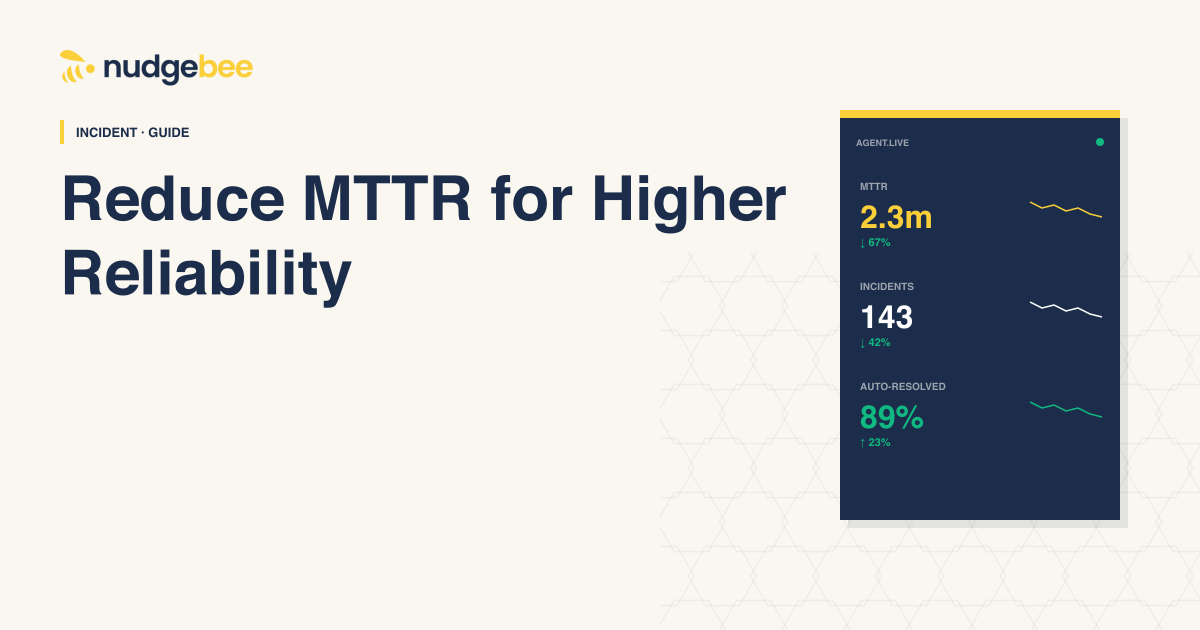
Enterprises looking to reduce MTTR and automate incident response.
Limitations:
Newer entrant than the incumbents on this list, so its ecosystem of third-party integrations and public case studies is smaller, and evaluating fit still means running a pilot on your own incidents rather than leaning on category-wide familiarity.
2. Sherlocks AI
Sherlocks AI is an agentic AI SRE platform that autonomously investigates production incidents and delivers root cause analysis in minutes. It integrates with existing observability tools like Datadog, Grafana, and Prometheus, deploys as SaaS or inside your own VPC, and is trusted by teams at Fynd, Lokal, and TradeIndia.
Key Features:
- specialized AI agents running in parallel when an alert fires
- correlation across logs, metrics and traces
- evidence-backed root cause with ranked remediation, delivered in Slack
Best For:
Enterprises that want to cut MTTR by moving investigation from hours of manual work to minutes of autonomous diagnosis.
Limitations:
Its focus is investigation and remediation rather than on-call scheduling, so it pairs well alongside an existing alerting tool.
3. PagerDuty
PagerDuty is one of the most widely used incident management platforms.
Key Features:
- alerting and escalation
- on-call scheduling
- incident tracking
Best For:
Large teams needing structured incident response.
Limitations:
Relies heavily on manual workflows and external tools for deeper analysis.
4. Opsgenie (being retired, plan a migration)
Opsgenie was a widely used alert management and on-call tool, but Atlassian closed it to new sales in June 2025 and support ends on 5 April 2027, after which un-migrated data is deleted. It is included here because a large number of teams are still running on it and need an exit plan, not because it is a current buying option.
Key Features:
- alert routing and prioritization
- on-call management
- integrations with DevOps tools
Best For:
Existing Opsgenie teams, who should be planning a move to Jira Service Management, Compass, or another platform on this list.
Limitations:
End of support on 5 April 2027; requires additional tooling for full incident lifecycle management.
5. Datadog Incident Management
Datadog offers incident management as part of its observability platform.
Key Features:
- monitoring and alerting
- log and metrics correlation
- dashboards
Best For:
Teams already using Datadog for observability.
Limitations:
Costs can increase significantly at scale.
6. Splunk On-Call (formerly VictorOps)
Splunk On-Call, which began as VictorOps before Splunk acquired it in 2018, focuses on real-time alerting, incident collaboration and response workflows.
Key Features:
- real-time alerting
- incident timelines and team communication
- integrations across the Splunk ecosystem
Best For:
Enterprises already standardised on Splunk.
Limitations:
Setup is involved and the learning curve is steeper if you are not already a Splunk shop.
7. ServiceNow ITSM
ServiceNow provides enterprise-grade incident management within its ITSM suite.
Key Features:
- ticketing and workflows
- enterprise process automation
- compliance and governance
Best For:
Large enterprises with structured IT processes.
Limitations:
Heavy, slower to adapt, not optimized for modern cloud-native environments.
Key Differences: Traditional vs. AI-Agentic Incident Management
| Feature | Traditional Software | NudgeBee (AI-Agentic) |
|---|---|---|
| Root Cause Analysis | Manual data correlation, relies on engineer expertise | Automated analysis of logs, metrics, and traces with AI-powered insights |
| Remediation | Manual execution of runbooks, high potential for error | Automated workflows and pre-built AI assistants execute fixes |
| Workflow | Rigid, linear ticketing process | Flexible, customizable AI-agentic workflows |
| Learning | Relies on post-mortems and manual documentation | Learns from every incident to improve future responses and provide predictive insights |
See Faster MTTR
Learn how AI diagnostics and automation reduce resolution time.
Key Features to Look for in Incident Management Software
1. Automation
Look for tools that can:
- automatically detect incidents
- trigger workflows
- reduce manual intervention
2. Root Cause Analysis
The software should help identify why an issue occurred, not just notify you.
Related: the best root cause analysis tools, if RCA depth rather than on-call routing is what you are optimising for.
3. Integrations
Ensure compatibility with:
- Slack
- Jira
- cloud providers
- monitoring tools
4. Scalability
The tool should support:
- multi-cloud environments
- Kubernetes
- large teams
5. Ease of Use
A complex interface slows down response time during critical incidents.
How NudgeBee's SRE Agent (NuBi) Accelerates Troubleshooting
At the heart of NudgeBee is NuBi, a dedicated AI SRE agent. NuBi acts as the first responder to any incident:
- It consumes event sources from all your monitoring tools.
- It uses AI to prioritize alerts, cutting through the noise.
- It provides engineers with a summary of the incident, evidence for the root cause, and recommended fixes.
This dramatically reduces the initial investigation time, allowing engineers to focus on validation and resolution rather than diagnostics.
One View, All Clouds
Analyze incidents across AWS, Azure, and GCP in one place.